Many Cultures, One Prepared Environment: Honoring Every Family While Preserving Montessori
Walk through the halls of almost any Montessori school today, and you will hear it before you see it: a child greeting a friend in Spanish, a grandmother at drop-off saying goodbye in Gujarati, or a father reminding his daughter in Navajo (Diné bizaad) to wear her jacket. At Montessori ONE Academy, our families bring traditions, languages, foods, faiths, and ideas about childhood that span continents. That richness is one of the things I am most grateful for as Head of School.
It also raises a question I hear from Guides and fellow school leaders more than any other. How do we honor every family's culture without losing the routines that make a Montessori environment work? When a family's expectations about mealtime, independence, or discipline differ from the classroom's rhythm, which one gives way?
My answer, after years of sitting with this question, is that we have been framing it wrong. Culture and routine are not competitors for priority. Held well, each makes the other stronger.
Montessori Was Built for This
It helps to remember that Montessori education was never meant to belong to a single culture. Dr. Montessori's work began in Rome, but it grew through years spent in India, the Netherlands, Spain, and beyond. Her later writing returned again and again to the idea that education is how humanity builds peace and that the child is a citizen of the whole world before she is a citizen of any one nation.
That vision lives in the materials themselves. The puzzle maps, the land and water forms, the study of the Fundamental Needs of Humans, and the stories of Cosmic Education: all invite children to see that people everywhere share the same needs for food, shelter, belonging, and meaning, and to meet those needs in beautifully different ways. A Montessori environment that celebrates many cultures doesn't merely add to the philosophy. It lives the philosophy as intended.
Routines Are the Container, Culture Is the Content
The most useful distinction I have found is this: routines are the container, and culture is what fills it. The uninterrupted work cycle, the predictable order of the day, the way materials return to the shelf, ready for the next child, and the expectation that we speak softly and move with care. These structures exist for developmental reasons. They give children the security and freedom to concentrate, choose, and build independence.
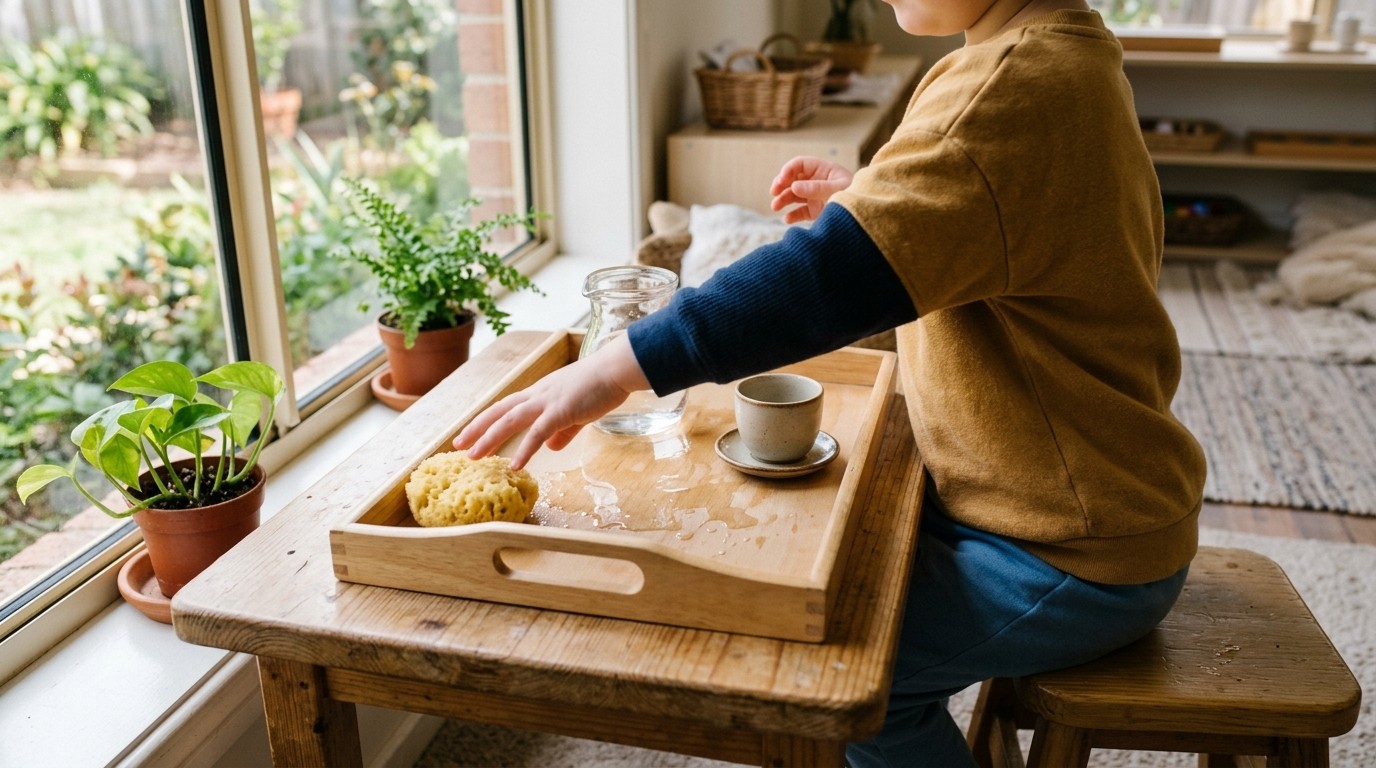
Culture lives within that structure rather than against it. A snack routine can hold tortillas one week and idli the next. A grace and courtesy lesson on greeting a guest can include a bow, a handshake, or a hand over the heart. A practical life tray can teach a child to pour chai, roll dough, or arrange marigolds, and the developmental purpose of order, coordination, concentration, and independence remains the same.
When we see it this way, the question changes. We stop asking which to prioritize and start asking how the routine can bring each family's culture into the room.
Bringing Culture into the Prepared Environment
Practical life is often the most natural entry point. Our Guides invite families to share a task from home, such as folding cloth the way a grandmother does, grinding spices in a small mortar, or setting a table with the utensils a family actually uses. Once the work is introduced, it follows the same sequence as other practical life work. The child observes, practices, repeats, and eventually owns it.
Food and snack time offer another daily opportunity. Rotating snacks from families in the classroom, with each family invited to share the story behind the dish, turns an ordinary routine into a quiet lesson in geography and belonging. The routine of washing hands, preparing, serving, and cleaning up never changes; only the plate does.
Language deserves deliberate care. Songs, greetings, counting, and the names of everyday objects in the children's home languages help each child hear their family's voice in the room. Labels and books in multiple languages tell children, without a word of explanation, that their language belongs here.
The materials and walls should reflect the children who use them. Photographs, artwork, musical instruments, textiles, and books should represent real families and real places, selected with the same care for beauty and authenticity that guides every other choice in the prepared environment.
Celebrations work best when they grow from families rather than from a calendar of holidays. Inviting a parent to share how their family marks a new year, a harvest, or a festival of light, and presenting it as part of the continent study or the story of humanity, keeps the focus on understanding rather than on spectacle.
Beyond Thanksgiving and Christmas
Many schools, including Montessori schools, default to a calendar without ever deciding to. Thanksgiving crafts appear in November, a tree goes up in December, and the year's other celebrations pass without notice. No one intends to leave anyone out, but children notice which celebrations fill the room and which never appear. A child whose family marks Diwali, Eid, Lunar New Year, Hanukkah, Día de los Muertos, or a Pueblo Feast Day learns something quiet and lasting when her traditions are invisible at school.
Thanksgiving deserves particular thought here in New Mexico, home to 23 sovereign tribes, nations, and pueblos: nineteen Pueblos, three Apache tribes, and the Navajo Nation, along with a large urban Native community. Native Americans make up roughly 12 percent of our state's population. The familiar story of Pilgrims and a shared feast is incomplete at best and, for some Native families, painful. Young children do not need the full weight of that history, but they also should not be taught a version that isn't true. Montessori's commitment to reality in the early years offers a better path: we can center gratitude, harvest, and the foods that came from this land, and invite Native families to share how they give thanks, on their own terms and only if they wish to.
Christmas raises a different question. For many families, it is a cherished celebration, and there is no reason to hide it. For others, it is not their holiday at all, and a month organized around it tells their children that school belongs to someone else. The answer is not to remove Christmas but to place it alongside the other celebrations our families bring, so that each becomes part of a larger story about how people around the world mark light, renewal, and togetherness.
There are pitfalls on the other side as well. A "month-of-the-holiday" approach can slide into tokenism, and asking the one child from a tradition to explain it to the class places an unfair burden on her. The healthier practice is to let celebrations come from the families who live them, to connect each one to the continent and culture studies already on our shelves, and to give every tradition the same care and seriousness. Some schools instead choose to center the year on the seasons and the natural world, which every family shares. Either path can work, as long as it is a deliberate choice rather than a default we never examined.
At Montessori ONE Academy, one way we make that choice visible is through our annual World Festival. On that day, staff, children, and parents all come dressed in clothing that represents their cultures, so the adults stand alongside the children as members of the same diverse community rather than as observers. Families and children share multicultural dance performances, and each class hosts an activity table featuring the arts and crafts of the country it is celebrating. Children move from table to table, trying their hands at the crafts of places their classmates, Guides, and staff call home.
What I love most about the World Festival is that it does not replace the everyday work of honoring culture; it grows out of that work. Each class chooses its country from the heritage of the children or the staff in that classroom, so every celebration begins with real people the children know, and the clothing and dances come from real families rather than from a costume box. It is a single day, yet it reflects something we try to practice all year.
When Cultures and Routines Genuinely Differ
Not every difference resolves neatly, and it would be dishonest to pretend otherwise. Among the most common tensions I see as Head of School are independence, mealtime, and discipline.
In many families, caring for a young child means doing things for them: feeding, dressing, carrying, tidying. That care is an expression of love and deserves to be received as such. Yet the Montessori environment asks a toddler to pour her own water and put on her own shoes. In these moments, our Guides begin by honoring the family's intention before explaining ours. A parent who hears, "You clearly take such good care of her," is far more open to hearing why we let her struggle a little with her zipper.
Mealtime raises similar questions. Some families eat with their hands, some with chopsticks, and some with spoons; some expect adults to serve children, while others expect children to wait until elders begin. The routine of preparing, sharing, and cleaning up can remain consistent even as specific customs vary. Children can understand that we do some things one way at school and another way at home, as long as neither way is presented as wrong.
Discipline and guidance are the most sensitive area of all. Expectations about authority, praise, and consequences vary widely. Here, we hold firmly to the philosophy’s core, which is respect for the child, freedom within limits, and guidance rather than punishment, while listening carefully to each family’s hopes for their child. Most of the time, families and Guides want the same things: a child who is kind, capable, and confident. The conversation is about how we get there together.
The principle I return to is simple. We can be flexible with form and steadfast in purpose. When a cultural practice and a routine differ, we ask what developmental need the routine serves and whether that need can be met in a way that also honors the family.
What School Leaders Can Do
Guides carry much of this work in the classroom, but leaders set the conditions that make it possible. It begins at enrollment. When we meet a new family, we ask not only about allergies and pickup arrangements but also about the languages spoken at home, the traditions that matter to them, how they comfort their child, and what they hope school will feel like. Those answers shape how a Guide welcomes that child on the first day.
Family partnership has to be ongoing, not a single orientation night. Parent education evenings that explain the reasons behind our routines, held in more than one language, when possible, build trust far more than any handbook. Inviting families into the classroom to observe and then to share something of their own turns them from visitors into contributors.
Our adults also need space for reflection. Every Guide, assistant, and administrator brings a cultural lens to what a well-behaved child, a respectful greeting, or a good meal looks like. Regular staff conversations about those assumptions help us notice when we protect a routine for the child's sake and when we protect our own habits.
Finally, our policies should align with our values. Calendars, dress expectations, food guidelines, and communication practices are all areas where a school either makes room for many cultures or quietly assumes one. Reviewing them with fresh eyes each year is a small practice with a large impact.
A Place Where Every Child Sees Themselves
The prepared environment has always been about meeting the child as she truly is. A child is not only a developing mind and body; she is also someone's granddaughter, a speaker of a language, and an inheritor of songs, recipes, and ways of being in the world. When we prepare an environment that reflects the whole child, we are not compromising Montessori. We are fulfilling it.
So the next time a cultural practice and a classroom routine seem to pull in opposite directions, I encourage you to pause and ask what each is really for. More often than not, you will find room for both: honoring the family, protecting the child's development, and building a community that looks a little more like the peaceful world Dr. Montessori imagined.
Tina Patel
Founder & CEO, noorana
Head of School, Montessori ONE Academy

Noorana is a free school management platform built specifically for Montessori schools, so leaders can spend less time on administration and more time with the families and children at the heart of their community. Learn more at noorana.app.